National Academy of Medical Sciences
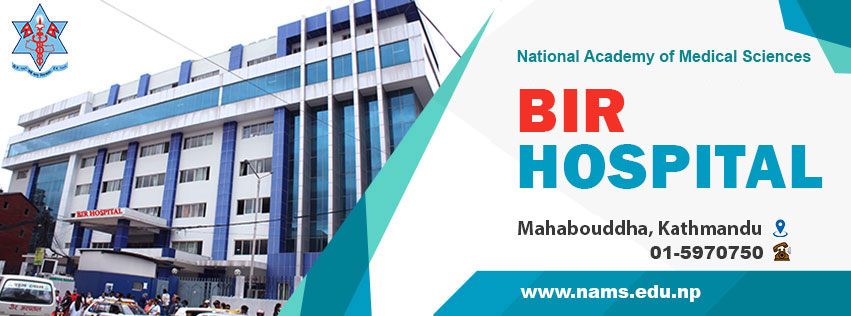
The **National Academy of Medical Sciences (NAMS)** was established to promote higher education and research in the field of medical science, produce skilled healthcare professionals, and provide quality healthcare services to the general public. The Academy's central office is located at **Bir Hospital, Kathmandu**. In English, it is known as the **National Academy of Medical Sciences (NAMS)**.
Bir Hospital is one of the oldest and largest hospitals in Nepal. It was established on **Shrawan 12, 1946 B.S. (1889 A.D.)** through the initiative of **Bir Shumsher**, beginning with just **15 beds**. In **1933 A.D.**, the hospital launched Nepal's first medical education program by establishing the **Civil Medical School**, which provided training for dressers and compounders. Nursing education was introduced at a later stage. In **1987 A.D.**, the hospital was recognized by the **Royal College of the United Kingdom** as a South Asian center for **FRCS, MRCP, and MRCOG** training. Subsequently, in **1994 A.D.**, postgraduate medical education leading to **MD/MS** degrees commenced through the **Post Graduate Medical Education Coordination Committee (PGMECC)**.
To support the overall development of Bir Hospital, strengthen quality medical education, and produce highly skilled healthcare professionals capable of making significant contributions to healthcare service delivery, the Government of Nepal issued an ordinance in **2059 B.S.** upgrading Bir Hospital into the **National Academy of Medical Sciences (NAMS)** as a premier academic institution. Later, in **2063 B.S.**, the Government enacted the **National Academy of Medical Sciences Act**, providing a legal framework for the institution. Since then, NAMS has been continuously conducting a wide range of academic programs, including **MD/MS** degrees, while promoting research-based education and academic activities in medical sciences and healthcare services.